


Industrias DOJE
Aluminum body for the new pickup Ford

Ford stole the show at the last Detroit Auto Show with the new generation of its pick-up F-150 has a body made of aluminum alloy. He said that the new model would weigh between 250 and 320 pounds less than the current, largely thanks to the use of aluminum, and it plans to market at prices close to those of the current (which range from 24 500 à 55 000 dollars). The new F-150 is part of the strategy to reduce the fuel consumption of the manufacturer. Ford has not given any indication on vehicle fuel consumption, but according to reports in the press, he would seek a highway fuel consumption of 7.8 liters per 100 kilometers.
Costs most important materials
The decision to replace the steel body of the most sold in the United States and most profitable Ford by an aluminum body vehicle could revolutionize the U.S. utility market, but also reduce the profits of the manufacturer. It implies higher cost of materials, significant investments in production tools and engineering, as well as the risk of setting complicated and troubled production and possible customer resistance. Also the problem of cost of repairing body panels and in turn the amount of insurance premiums.
Easy repair damaged panels
Ford noted in this regard that the model was designed to be repaired easily. It is also committed to financially assist dealers and repair shops for body panels damaged can be replaced or repaired at a competitive cost. Eric Noble, president of the consulting firm The CarLab, estimated that the use of aluminum would increase the cost of the new F-150 at least 1000 dollars, knowing that aluminum is about three times more expensive than steel.Source: www.ccfa.fr
Source: My little blog fonderie
New closed arms for luminaire in zamak

IRILUR S. L. - Lamps and accessories for lamps, has once again put its trust in us to create and merge their new closed arms for luminaire in zamak. After months of work we can say that their new design is ready to be added to IRILUR`s catalog of products.
Unlike the majority of companies of lamps or accessories for lamps, IRILUR S. L. takes you from the years 80 using the zinc alloy "zamak", applied with success to manufacture their lighting products, obtaining forms and geometries not possible with other materials with the exception of the plastics, And by another dramatic improvements of surface finish due to its dimensional stability and smoothness to the obtainable in the surfaces, by deleting processes of filing and polishing that fatally entered, in the brass castings and bronze, and to a lesser proportion in the bilberry, controllable little variations of the originally projected forms (especially in edges and curves of small radio). This protection is obtained either with organic coatings (paints, varnishes, lacquers and enamels) or by electrolytic coatings that, in the brasses are generally of nickel and chrome, and in the case of zamak tend to be copper-nickel-chrome.
Neither must we forget the possibility that has the zamak, like the other metals and certain plastics, coatings to incorporate the tribology of PVD (Physical Vapor Deposition), CVD (Chemical Vapor Deposition) or of PECVD (enhaced Plasma Chemical Vapor Deposition) or The most recent on the basis of nickel alloys and tungsten, which in certain cases are substituting or substituted for the coatings to electrolytic nickel base and chrome that, among the other characteristics do not affect the environment or the health.
The mechanical properties of a casting

A casting, either cast aluminum or steel, has static mechanical properties (Rm, Rp0.2, elongation) and dynamic (fatigue endurance limit) resulting from a number parameters (part design, alloying elements, ..., fineness of the microstructure).
Important factors
The main factors that impact on the mechanical properties (in both static and dynamic) of a part are:
- The content of alloying elements which enter into the chemical composition of the piece (Al-Si7Cu3Mg for an aluminum or 2.7% C, 0.6 Si, 4.2% Ni and 1.6% for Cr cast Ni-Hard)
- The absence of internal and external defects in the parts of mechanically stressed parts. Generally specifies an acceptable level of default (Class 1 for shrinkage in area designated for example) in the room CdC. The impact of defects on the mechanical properties can be understood finely
- The layout of the room (for example the absence of stress concentration areas or isolated solid areas)
- The type of microstructure obtained. For example, the shape of the graphite (flake, spheroidal, vermicular) or matrix (pearlitic, ferritic, austenitic, bainitic) for the font or shape of silicon (lamellar or acicular) or intermetallic compounds (Al-Fe-Si ) for the aluminum alloys
- The fineness of the microstructure (due to the rate of solidification). For some applications, and specifies the DAS (Dendritic Arm Spacing) in microns for aluminum alloys
- Micro-alloying elements in very small amounts (a few ppm to few% versus the traditional alloying elements)
- A subsequent heat treatment that modifies the microstructure (transformation of austenite to martensite in steels for example). For Al-Si alloys, for example, it is the addition of magnesium during the heat treatment allows to increase the mechanical characteristics
- Machining operations that can result in surface pores or cause residual stresses
- Subsequent treatment (local shot peening or hot isostatic pressing, for example)
Source: My little blog fonderie
Defect images tomography

Tomography is a new NDT technology (Non Destructive Testing) to obtain a 3D reconstruction of internal defects. Faults can thus be visualized and quantified with precision (spatial position, area, shape factor, ...).
What is the principle of tomography?
Tomography is to use a source radio (microwave hearth) on a workpiece or a sample rotation. The 3D image is then reconstructed by calculation.

Compared to other analysis of internal defects, the tomography means has advantages:
- True 3D image to visualize and diagnose finely internal defects,
- Quantification (Part geometry and defects)
But also imposes constraints:
- Cost of the tool
- Analysis time.
That allows to analyze the CT?
Tomography can do two things:
- From 3D dimensional control room
- From internal health control room
A founder may equip it?
Yes, some have begun to do so for dimensional inspection and health room. Customers or R & D centers are also equipped with a tomograph.
Quantification of internal defects
Micro-tomography, used by IWTC in an R & D has to acquire images with a resolution between 3 microns and 20 microns (1 voxel = 20 mm). Different materials were analyzed (Al Si9Cu3 Al Si12, Al Si17Cu3, zamak, magnesium, ductile iron, aluminum foam). The vast majority concerned the diecasting (Al, Zn) on the draft R & D.
Tomography provides access to the following information:
- Porosity rate (in an area of each)
- Pore diameter (average, min, max)
- Shape factor of pores
- Distance of the pores of the skin piece. This parameter is of crucial importance for the fatigue (in alternating bending, but also to a lesser extent in tension / compression) in the sense that defects very close to the surface initiate fatigue cracks.
However, all these data require an operation manual recount:
- Isolate the area of interest
- Perform a thresholding operation (transformation of an initial gray level image into a black-white binary image). The thresholding operation (image analysis) is clearly the most delicate.
- Erosion and dilation operations that eliminate noise (resulting from thresholding) and too small defects to have a number of pores easily analyzable.
- Analysis of the proper file for realistic rendering and transfer to an Excel spreadsheet.
Image processing
Analysis and quantification of pores
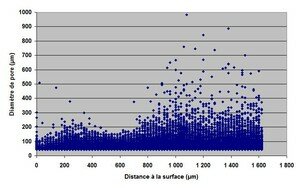
Distance to the surface (pore diameter and the ordinate) for an aluminum part 3.5 mm thick

Pores with respect to the workpiece surface (left and right) part.
Area skin part is relatively healthy.
Images of 3D tomography defects
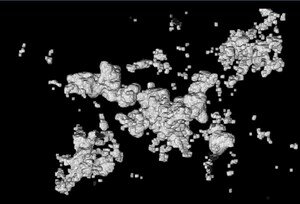
Micro-shrinkage (3D view) - Shrinkage
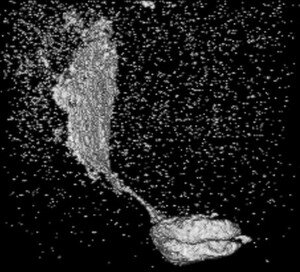
Recovery (3D view) - Cold shut
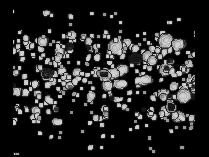
Blowhole (3D view) - Blowhole pores
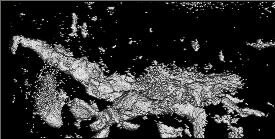
Shrinkage (3D view) without filtering - shrinkage (without erode and dilate operations)

Shrinkage (Al Si9Cu3)
Vídeos
A means of CND future
Tomography is a means of control that begins to emerge from the R & D and is led to the industrial development in the future as to access additional information relative to the fluoroscopy.
Source: My little blog fonderie
Merry Christmas and a Happy New Year

From DOJE INDUSTRIES S.L. we want to wish you a Merry Christmas and a happy 2014, full of health, labor and success.
Filler Video casting machine

Excellent video where you can see step-by-step the filling of a piece of aluminum and plastic at the same time, using a new casting machine.
The foundry institute of RWTH Aachen University presents the new developed hybrid multi-component high pressure die casting process. With this process the possibility is given to manufacture a composite part of two materials (aluminum and plastic) with one tool and one machine.
The silicon foundry alloys

Silicon is the element of controlling almost all alloy aluminum alloys foundry both gravity sand casting and shell (Al Si7Mg0.3 Al Si12, Al Si7Cu3, ...) in die casting pressure (Al Si9Cu3Fe Al Si17Cu3). Silicon is also used in ferrous alloys where it is added in the form of ferrosilicon. There are essentially three qualities of industrial silicon are distinguished by their level of impurity. The metallurgical silicon has a low level of purity while electronic and solar photovoltaic applications require a purity level much higher. Various forms of silicon
THANK YOU FOR YOUR VISIT TO OUR BOOTH AT SUMMIT 2013

DOJE INDUSTRIES S. L. , wishes to thank all the visitors that have come to our booth at SUMMIT 2013 (Bilbao) the days 1, 2, 3 and October 4 and have been interested by our services consists of cast Zamak and aluminum.
We would also like to thank all our customers for letting us share some of their pieces of zamak and aluminum, and also by his visit.
For those who want more information on industries DOJE S. L. , will leave you this link where you can download a Power Point presentation of our activity focused on the production of parts by injection in aluminum alloys and Zamak.

Handling of Aluminum by Goldman Sachs

The North American investment banks Goldman Sachs and JP Morgan are accused of manipulating the price of aluminum by moving their stocks from different warehouses, generating queues in order, longer delivery times, generates premiums for customers wishing to be delivered quickly, which affects the entire market and can artificially inflate the price of the metal.

Several complaints
The complaint stems from a large trans-Atlantic users of aluminum, MillerCoors, a brewer using cans. According to MillerCoors, the aluminum price was inflated by $ 3 billion last year worldwide. Another complaint partnership has been filed in Florida, August 7, accusing the London Metal Exchange (LME), Goldman Sachs, JPMorgan Chase and Glencore Xstrata cartel in aluminum storage.
The technique of suspected fraud
The process is simple because the law requires holders of aluminum to physically go out every day 3,000 tons of their warehouse but it does not say that the aluminum to be delivered. Then just move legally aluminum of a warehouse to another. Goldman Sachs and physically stores of aluminum in 27 warehouses around Detroit. The New York Times, after an investigation revealed that a fleet of trucks will carry a daily aluminum and forth between a warehouse and another. This movement of goods would lengthen delivery times can spend six weeks to over a year. And storage is longer and the invoice to the customer is high for those who want to be delivered quickly pay a premium.
The control of raw materials by banks such as Goldman Sachs' allows them to both predict and influence commodity prices and thus determine the pricing of derivatives and hedge funds in particular on raw materials "says U.S. News.
The role not so clear LME
The LME (London Metal Exchange), which should play a regulatory role in this market is not neutral and is involved because the LME affects 1% of the rental of warehouses and is far from being independent since held until last year by banks with Golman Sachs.
The Fed survey
Given the spate of allegations of fraud, the U.S. central bank (Fed) investigates the physical assets of raw materials held by many banks. In particular it could return to the authorization granted in 2003 to conduct such activities in addition to their sawmills derivatives and commodities brokerage.
Denial of Goldman Sachs
The bank denies any dispute handling and the storage of aluminum can drive up prices. They readily believe, given the reputation of profound honesty that surrounds all of their activities.
Source: www.bfmtv.com
Source: My little blog fonderie
Produce in China and Eastern Europe "no longer has much sense"

Automobile companies recognize that produce in China and Eastern Europe "no longer has much sense" and warning that "has created a bubble around the electric car".
But it should improve infrastructure, for example, betting on the Mediterranean corridor. Another important consideration is the excessive taxation we support.
Car manufacturers seem to be more focused on improving their conventional combustion vehicles in almercado hasten the electric models.
SOURCE and extended news: Expansion.com
Blog
-
Surface Treatments in Die Casting: A Guide to Finishes for Zamak and Aluminum Written on Thursday, 24 September 2026 09:05 in Fundición inyectada

-
Cost Optimization and Energy Efficiency in Die Cast Parts - INDUSTRIAS DOJE S.L. Written on Tuesday, 08 September 2026 09:20 in Fundición inyectada

-
DFM Optimization: How to Design Die Cast Parts to Reduce Production Costs Written on Wednesday, 01 July 2026 07:10 in Fundición inyectada

-
Die Casting: When to Choose Zamak vs. Aluminum for Your Industrial Parts Written on Wednesday, 17 June 2026 07:29 in Fundición inyectada

-
Innovation and Precision in Zinc (Zamak) and Aluminum Die Casting: Tailored Solutions for Industry Written on Friday, 13 February 2026 10:19 in Fundición inyectada

-
Subcontratación. From 6th to 8th june, 2019 Written on Thursday, 16 May 2019 11:48 in Actualidad

-
DOUBLE COIN KEYRINGS Written on Wednesday, 13 March 2019 10:15 in Fundición inyectada

-
4 FUNCTIONS CLEVY KEYRING Written on Wednesday, 06 March 2019 13:31 in Fundición inyectada

-
Advertising products works Written on Tuesday, 24 October 2017 08:52 in Fundición inyectada

-
10 REASONS TO CHOOSE DIE CASTED ZINC Written on Wednesday, 30 March 2016 09:14 in Fundición inyectada

-
Alloys Used in Die Casting Written on Tuesday, 20 October 2015 12:57 in Fundición inyectada

-
Optimized design of molds for injection molding and sustainable Written on Friday, 18 September 2015 10:49 in Actualidad

-
Subcontratación. From 26th to 29th May, 2015 Written on Monday, 27 April 2015 11:38 in Actualidad

-
Composition of casting zamak Written on Thursday, 09 April 2015 09:25 in Zamak

-
The Importance of Die Casting Services Written on Monday, 15 December 2014 10:35 in Actualidad

-
Zamak in jewelry Written on Monday, 16 February 2015 07:38 in Zamak

-
Surface finishes Written on Monday, 29 September 2014 13:18 in Zamak

-
Numerical simulation of filling pressure casting Written on Friday, 13 June 2014 07:34 in Novedades

-
The advantages of zinc casting alloys Written on Monday, 29 September 2014 11:57 in Zamak

-
New closed arms for luminaire in zamak Written on Friday, 21 March 2014 00:00 in Zamak

-
Aluminum body for the new pickup Ford Written on Thursday, 24 April 2014 06:54 in Aluminio

-
The mechanical properties of a casting Written on Thursday, 30 January 2014 11:48 in Aluminio

-
Defect images tomography Written on Friday, 20 December 2013 09:23 in Zamak

-
Merry Christmas and a Happy New Year Written on Thursday, 19 December 2013 14:44 in Actualidad

-
Filler Video casting machine Written on Thursday, 14 November 2013 08:50 in Aluminio

-
The silicon foundry alloys Written on Wednesday, 06 November 2013 14:50 in Aluminio

-
THANK YOU FOR YOUR VISIT TO OUR BOOTH AT SUBCONTRATACIÓN 2015 Written on Friday, 05 June 2015 07:00 in Actualidad

-
THANK YOU FOR YOUR VISIT TO OUR BOOTH AT SUMMIT 2013 Written on Wednesday, 16 October 2013 11:03 in Actualidad

-
Handling of Aluminum by Goldman Sachs Written on Monday, 16 September 2013 06:45 in Actualidad

-
Produce in China and Eastern Europe "no longer has much sense" Written on Tuesday, 03 September 2013 08:08 in Actualidad

